Abundance.

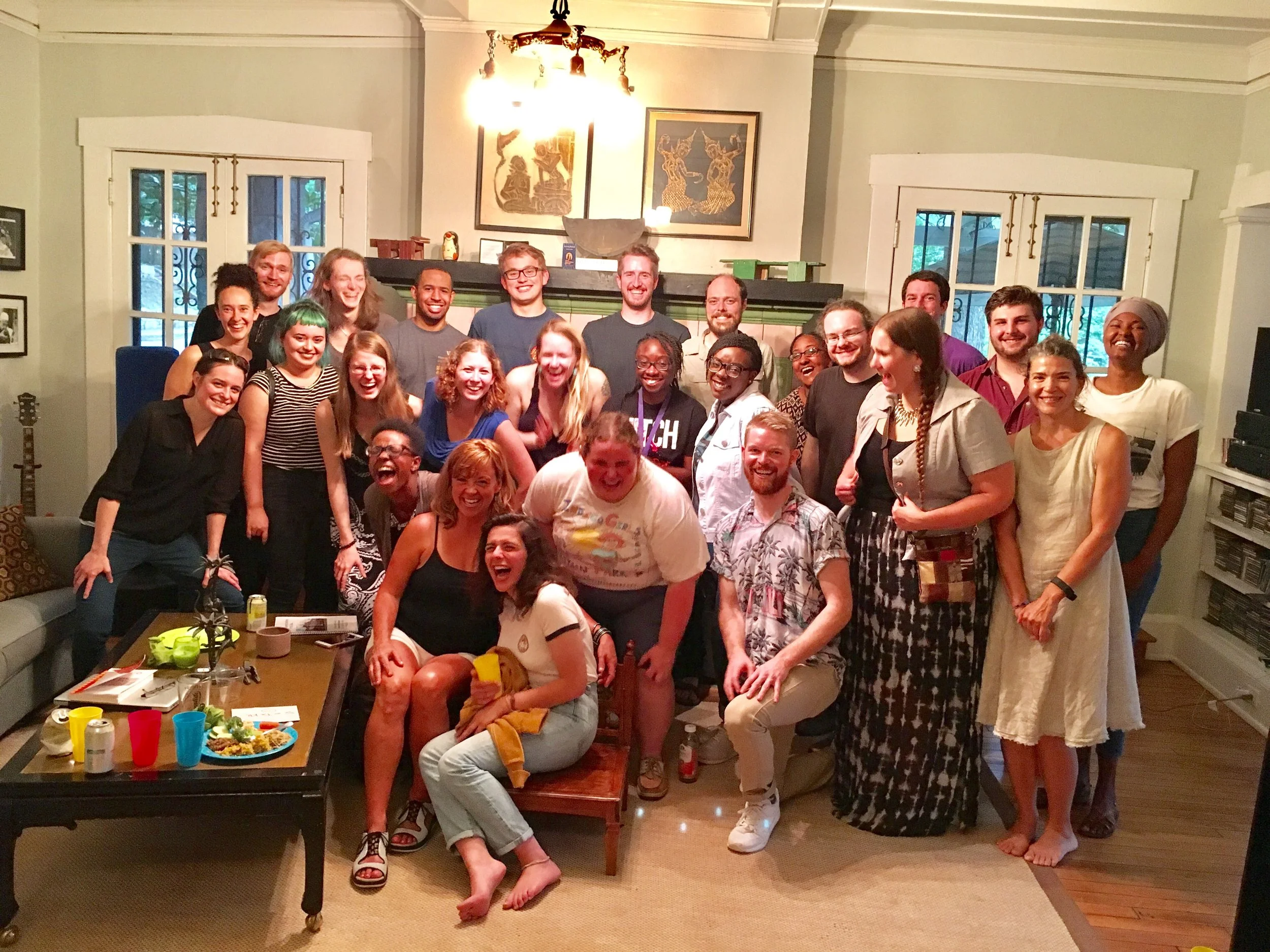
Thanks for indulging me for a selfie, friends! 

Thanks for indulging me for a selfie, friends! 

"Claire, how many styles of writing are there?" A question from my friend after writing group the other night.

My friend may have been looking for a more specific answer, but the following words immediately popped out of my mouth: "Well, I think there's probably as many styles of writing as there are people in the world." 

We had just come from an hour and a half of sharing our words--starting with a writing prompt about a fall memory, followed by four pieces that individuals had written outside of our gathering. I marveled, as always, at the wonderful variety--in subject matter, voice, length, point or lesson shared. Perhaps especially in our pieces about fall--everyone putting pen to paper or fingers to keys for the same ten minutes, given the same subject--I smiled at our diversity of reflections. People often feel led to preface their piece by saying, sometimes apologetically, "Well, I took the prompt a little differently..." But that's the last thing they need to be apologetic about.

Over Labor Day weekend, I attended a panel at the Decatur Book Festival called "The Life of Writing and the Writing of Life." My first response was that it was too short--only 45 minutes--to cover the many topics that fall under the umbrella of that subject. But a big chunk of the conversation between Richard Nash and Yale professor Amy Hungerford was that of abundance and scarcity in terms of writing, especially in terms of being published. We produce far more books than society could ever deal with, they said. And, of course, for all the books that are produced, how many thousands upon thousands never do?

In that panel, they also talked about how someone's piece can be stumbled upon, discovered almost by accident, that accidents are part of the way that culture--what books happen to be published and assigned in high school and therefore ingrained in our collective psyche--comes to be formed. They asked: What kinds of cultural conditions allow writing to happen, and what conditions thwart writing?

This was a fascinating conversation that I wish could have gone on and on. But it also led back to a conversation I had with another friend and client recently, an older friend who has recently made the brave and wonderful decision to record life on the page. "How do you become a writer?"

"Pretty simple," I said. "You write."

"So I write a lot of letters, and I'm a writer?"

"Well, in a sense, I'd say yes. I guess I should amend my original response to say, if you are engaging with whatever you are writing--if you are making an effort, if you get into the process, discovering new things about yourself or others...You're a writer."

Yes, I continued, there is the distinction between writers and published writers, and those two journeys--although even that can become blurred these days with the rise of self-publishing. But in the moment, in the process of writing, we can't think about that. We shouldn't. We should write for writing's sake, for the uncovering of what came before, or what is happening now. 

"Abundance breaks more things than scarcity." During the DBF panel, Nash quoted this from Craig Sherky. That means, Nash went on, when we have an abundance of words, of writers, more get left behind in terms of recognition or readership. Fewer people's words are lifted up into our general consciousness.

But I have to stand up at my minuscule microphone, in the midst of billions on the Internet, for just a moment, and say: That isn't the point. I rejoice in the abundance of words, because they are all unique to the human beings writing them. I rejoice in the abundance of human beings who feel like they have a story to tell, because they do, and someone will benefit from it, even if it is only the writer her/himself. That's one of the many reasons I love leading writing groups and working with people who have made the choice to hash out life on the page. Every human's story, their many stories, are fascinating, personal and yet at the same time, universal.   

The styles of writing are limitless. So are the people they belong to. We won't encounter all of them in our lifetime, but for the ones we do, let's pay attention. Let's listen, and read, and try to understand along with them. And let's be inspired by those who are telling their stories, so that we might find the courage to tell our own.

An abundance of stories--I can't see a single thing wrong in that. 

The Friday Five: Step it out.

Oh, fellow humans. It's Friday. I'm zonked. Can we have a three-day weekend again, please?

Speaking of three-day weekends, we had a nice one. Didn't go anywhere, which made it all the nicer. We ate out, took naps, went for a jog, to church, and--

We spent one more evening this summer at our favorite concert venue with Collective Soul and the Goo Goo Dolls. Chastain Park Amphitheatre really is the best--you sit in this big bowl of sunlight and eat your picnic dinner as night falls and the music rises. I hadn't seen Collective Soul live in 11 years, and damn are they good. Plus, it's always satisfying to actually be able to sing along at a concert. Goo Goo Dolls were also good, but their stage lighting was WAY too bright. I don't think I'd ever put on my sunglasses at 9:00 p.m. before.

I also reread The Cuckoo's Calling by Robert Galbraith, AKA J.K. Rowling. It's the first in her mystery series featuring Detective Cormoran Strike, and it made me wish that he/she'd publish another right this second. Shiny magic or rugged mystery, it doesn't seem to matter--her way with character development and subtle humor is always there. (Speaking of mysteries, I can't wait to get the new Louise Penny book, A Great Reckoning. Armand Gamache and Strike couldn't be more different... and yet now I'm wondering what would happen if they met...) 

I didn't even mind going back to work because it meant that we could welcome our dear friend and coworker back from maternity leave. It's been so nice to have Lisa back in the office, and I love that now there's a sweet little boy to ask after, too.

Somehow, I've managed to get more than 8,000 steps every day this week. I don't think that's ever happened before in a mostly regular work week, and I'm thrilled. Reasons for this rise in steppage (can that be a word if it isn't already)? I do some kind of Jessica Smith walking workout every day, whether it's with my fitness group or on my own before work. Sometimes I'll go on a walk with a coworker before it gets too hot. But mostly, I think, it's been the addition of a few flights of stairs throughout the day. I walk down to the first floor and up to the fifth floor for no real reason at all, and it feels great. We have a step challenge coming up at work, and I'm excited for more motivation to get myself worn out in a good way by the end of the day.

What about y'all? How was your Labor Day weekend? Is the air getting crisper where you are yet? (If so, I'm jealous.) What got you through the week?

Happy Friday!

Fine Folks//Creative Callings: MJ Lee., Singer-Songwriter

I first knew San Francisco Bay Area-based musician MJ Lee. as my good friend Mejin Leechor. We're celebrating ten years of friendship this month, when we met at Davidson College's Methodist Fellowship group. Ever since, I have been in awe of her compassion, creativity, musical gifts, and commitment to living an authentic life. That combination has been integral to the release of MJ's wonderful debut album, The Lights Ahead, which released last week. Not only are her tunes fun and memorable, but her lyrics paint a journey that all of us can relate to: figuring out who we really are in the midst of society's messages, claiming our story, and acting on what that means for our lives. Enjoy the interview, and be sure to listen to the album after the final question! 

What role did music play for you as a child and teenager? How has that role changed as you've grown and experienced more of life?

My relationship with music began with my mother, a lifelong music lover who grew up in Korea and dreamed of playing the violin. When I was four, she enrolled us both in beginner violin lessons—she was a much faster learner than I was! Thanks to her, my childhood was filled with music: school orchestra during the day and group classes on weekends. It didn't take long for me to start spinning melodies of my own—I've been composing for almost as long as I can remember.

Getting my first taste of pop music was a revelation. It was late in elementary school; I would listen to the local pop station on my clock radio with my ear pressed against the speaker. The right combinations of words and melody hit me in the gut, speaking directly to my emotions and amplifying my feeling of being alive. I knew I wanted to write songs—to create musical experiences that could move others the way I was moved when I heard a powerful song. When I was 12, I sang my first finished song at a summer camp talent show. Songwriting became one of the primary ways I learned to express myself and make sense of my world.

By the time I was a teenager, I had a musical ambition: I wanted to rock the stage. I had a clear mental picture of myself performing the songs I had written for audiences. What I didn't have was an understanding of how to get there or people in my life who could support and direct me. At the same time, competing messages from my environment told me that music could only be a hobby and that my real ambition should be to go to college and pursue a respectable vocation, say, a doctor or engineer. I gave in. By the end of high school, I had stopped writing songs.

As I've experienced more of life, I've learned to trust my own instincts. I've returned to songwriting and music-making in adulthood with a renewed sense of purpose and conviction. It no longer matters to me what other people think. My priority is to be true to myself and to the love that drives me. 

I first knew you as a stunning violinist in college, and have loved following along as you have branched out to songwriting and performing. How did you make that transition, both technically and emotionally?

In hindsight, it's amazing that such a core part of my being was completely shut down during my college years. Many people who knew me well in college are surprised to learn that I wrote songs when I was younger.

When I came back to songwriting in my 20s, I was years out of practice. I struggled with writer's block and a harsh inner critic. I tried all sorts of writing and creativity books and classes to break through the block, but what helped me the most was cultivating my own practice: showing up to write over and over again, even if I was afraid. Especially if I was afraid.

I've found that the same is true for performing: showing up is half the battle. The other half is trust—trusting yourself and giving yourself to the music. 

You're originally from the East Coast, but moved out west a few years ago. How has that physical transition impacted you?

That's right—I grew up in the suburbs of Washington, D.C., then moved west to the San Francisco Bay Area after finishing college (with you!) in North Carolina. I absolutely love it here: I'm inspired by the landscape, the spirit of possibility, the Asian American history—everything except the cost of living, really! I love the people and community I've found, too: the ways they dream and explore and how they work to heal the world and reimagine the ways we live in it. That say-yes approach to life has been so valuable for me to witness. It helps me feel supported in being who I am and growing as a person and a musician.

From what I know, I get the sense that you are striving to live your most authentic life. A big part of that includes pursuing this vocation that gives you great joy. Was there a moment when you actively decided to live into this calling, or did it come about gradually? How does it feel to be within it now?

Two moments come to mind.

The first is the moment when I realized it was time to come back to music. It was the summer of 2011, and I was on a backpacking trip with some friends. On the third or fourth day of the trip, I had a lightning bolt realization: I was going to be a musician. The thought made little sense at the time: I had just finished graduate school and was starting a career in a field unrelated to music. I hadn't written a song in seven years and had no idea how I was going to begin again. But at an instinctual level, I felt as though I had remembered my reason for being. For the rest of the trip, my mind was flooded with song ideas. I was still some years away from developing the skills to turn ideas into full-fledged songs. But I couldn't shake the memory of that realization, wild and improbable as it seemed. 

In the fall of 2013, I finally buckled down and committed. I enrolled in a songwriting class and started showing up at open mics in San Francisco. I started writing every day. After that, the process was gradual. There were still a few upheavals ahead, including leaving a job that would've been a step forward in my not-music career. But that fall was when I found my resolve, and there was no turning back.

Living into my calling feels like being on a moving train, destination unknown. But every day, my job is the same: to show up and give all my love and sweat to bringing my vision to life. Even when I'm not sure how I'm going to get there, I know I'm on the right path. I've never felt so clear and committed to anything before. 

On the whole, what is the greatest lesson you've learned so far from striving to live authentically? I feel like this is a big concept in our culture of social media personas, fear of the other, what defines success, and on and on.

I appreciate this question. There are so many lessons to learn, but what comes to mind now is that it takes strength and courage to live authentically. Facing the world with an open heart isn't always easy or sexy or cool. It'll cost you something to live this way, and you'll probably encounter resistance in yourself and others. But persevere. Have faith and remember that you're showing love to yourself and others by being the person you are, not the person you think other people want or expect you to be. 

I feel like the questions above relate to the concept of transition, and your debut album, The Lights Ahead, relates to this as well. On your website bio, it says, "the six-song concept album tells the story of her artistic coming-of-age and the transformation of a creative vision into lived reality." Can you talk about how you came up with the creative idea for this album, and how you went about crafting the songs themselves? I don't know much about a songwriter's process, and I'm sure it's different for everyone!

When I started planning the album, I had written all but two of the songs. The theme came together quickly because I had been living it: the image of the lights ahead seemed to capture the promise and yearning that kept propelling me forward on my musical journey, even while I felt like I was still fumbling in the dark. I knew the album would be relatively short for cost reasons and because that felt like the best way to approach a debut. I used the theme to determine which of the songs I'd written did and didn't belong (no love or breakup songs, for example), and then I put them in order to create a narrative. "The Lights Ahead" and "Meant to Be" came last—I realized I needed a few more parts to make the story cohesive.

Each individual song had a unique birthing process. Some came from tinkering at the piano while others implanted melodies in my brain. I wrote the lyrics to "A Little While Longer" before setting it to music, which is a little unusual for me—I often write music before lyrics. But that's part of what I find so exciting about songwriting: each song demands to be taken on its own terms, and there are no hard and fast rules. 

From start to finish—idea to finished product—about how long did it take for the album to come to life?

I finished writing most of the songs in early 2014 and had the album idea around that time, so it's been over two years. I started recording last September. 

Wow! You've really lived with this a long time. Do you have a song that was your favorite to write? A favorite to perform?

It's tough to play favorites! But "Shine" was one of the highlights of the writing process—it felt like a pure outpouring of my heart into song. "It's Time" is fun to perform because I bring in audience participation. It's wonderful to hear people sing along and become part of the music.

"Shine" is one of my favorites on the album. I often have it in my head these days—it really feels like a song that says "Wake up! Enjoy life!" Who are some of your musical influences, on this album and in general? 

Jonsì, lead singer of the Icelandic post-rock band Sigur Rós, has a beautiful solo record called Go Do that inspired me a lot while I was working on The Lights Ahead. His music is sheer exuberance and ecstasy, with natural and electronic elements joining in ways that make my heart flutter.

Beyond that, my musical influences are all over the map. Some people hear classical influences in my music, and that's undeniable. I listened to a lot of alternative and emo in high school, so that's in there, too. These days, I share community with other singer-songwriters in the local scene; I'm sure we learn from and influence one another.

I love the many natural, external elements you call upon in your lyrics—light, water, dust, caverns, cliffs, mountains, fog—and how they connect to your internal journey. How did those metaphors first appear to you?  

I often find myself writing and reflecting when I'm surrounded by natural beauty. There's a wildness and freedom in nature that fuses with my creativity, and the metaphors come unbidden. I wish I had a better explanation! Honestly, it feels a bit magical. I will say this: I carry a notebook with me everywhere. 

In your song "A Little While Longer," you sing, "you won't stop now that you're finally here." What does "here" mean for you right now? And you also sing, in the title song, "I've been dreaming of the lights ahead." How do you envision the lights ahead in your own life? 

For me right now, "here" means I'm beyond the point of no return. I've got a Kickstarter campaign and an album under my belt, and I'm sharing my music publicly. This isn't just a dream anymore—it's real. My "lights ahead" are my hopes and dreams of making a life in music full-time and connecting to people around the world with my songs. 

What would you say to someone who might be struggling to live authentically, or find her/his place and passion in the world?

Tune in. Listen to the truth inside of you—you know it already. Be courageous. 

Listen to MJ Lee.'s album, "The Lights Ahead."